
I love macro photography. When I pull out my macro lens, my view of the world shifts. My steps slow, my visual field narrows, and I notice so much more than I usually do. I look past “the big picture” – without effort – so that I can look at the world in a completely different way. I suspect that some of you know exactly what I’m talking about. You’ve been there.
Here are a few tips practical tips for capturing stunning macro photos:
#1: Slow Down
Don’t plan on hiking 10 miles. You don’t have to go far to find incredible tiny landscapes. They’re literally everywhere! You just have to notice them.
Here is a shot I took on the Big Island of Hawaii in a gorgeous spot – waves pounding the rocky shore on one side, and lush rain forest on the other. I noticed these tiny water droplets strung like pearls on a spider’s web. So, of course, I pulled out my favorite lens for macro photography and got down to business.

Slow down to find macro subjects like spider web covered in due – Big Island, Hawaii
Capturing a shot like this is tough. Even with a macro lens, it was hard to get in close enough for the shot I wanted. And the slightest breeze was enough to keep the web dancing – so getting a sharp picture required patience.
I took several shots – hoping that I could get one that was sharp. Thanks to a few moments of stillness, the photo I took with a 1.6 second shutter speed (ISO 100) is cleaner than another I took with a 1/6 second shutter speed (ISO 400.) Sometimes, you just get lucky.
#2: Use a Tripod
My tripod is critically important when I’m photographing tiny subjects, because I need to be able to set up my camera (often at odd angles), and then adjust my settings quickly and efficiently. For a living subject – like my little gecko friends – I might not tighten my ball head, so that I can pivot my camera as my subject moves. The tripod provides far more stability than I can accomplish, even when the head is not fully tightened. If I need to be able to move my camera quickly, and also need a broad range of of motion, I sometimes fold my legs together and use it as a monopod. The extra stability means I can worry less about motion blur, and I can relax a little when it comes to shutter speed. When I was shooting these geckos, that simple trick gave me the stability, mobility, and flexibility I needed – while also allowing me to make quick adjustments, and keeping my arms from getting too tired from holding a heavy camera and lens.

Use a tripod as a gimbal for moving subject
In the above image I chose to set up my camera and tripod so that the gecko’s long body aligned with my plane of focus. I focused on the eyes of the little creature, which were lifted towards me – so the body is slightly out of focus. Notice that the edge of the tree trunk is soft. That’s because the trunk falls out of the plane of focus as it curves away from my lens.
#3: Look for Patterns
Patterns and repetition can be used to simplify the image and create a visual impact. I have hundreds of examples that show repeating patterns, a narrow depth of field for a simplified background, and compositional elements arranged within the plane of focus.
-

Using patterns for macro photography by Varina Patel
-

Look for irregularities can create point of interest


Elements that break a pattern can make excellent points of interest. The green mark on the leaf in the photo below gives your eye a place to rest amidst the complicated pattern of veins on this autumn leaf.
#4: Pay attention to your background
The background is just as important as the subject. Pay attention to every detail of your shot. Look for distracting elements that might pull your viewers eye away from the subject. Think about how much detail you want in the background. I often take a series of shots of a single macro subject – trying different aperture settings until I get just the right amount of detail in the background. Not too much, and not too little. Of course, that’s up to the artist to decide!
-

Wide Aperture to create artistic bokeh for macro subject
-

Narrow aperture create uninteresting background for the macro subject


I prefer extremely minimalist backgrounds, and I use a variety of techniques to simplify an image and draw attention to my subject. From using a wide aperture to produce a narrow depth of field, to seeking out small scenes that showcase a single color for a monochromatic composition.

A monochromatic image with a simple background
#5: Make the most of your plane of focus
Align elements that you want in focus along a flat plane, and keep that plane parallel to your camera’s sensor. When I’m working with a macro lens, I’m often dealing with a ridiculously narrow depth of field, so anything outside my narrow plane of focus will be blurred. For this shot of a calla lily, I adjusted my camera very carefully to be sure it was aligned as accurately as possible.

Photography composition selected to keep focus plane parallel to Calla Lily, California
I brought my tripod down low to the ground and locked it in place. I aligned my camera and lens so that the tip of my subject was sharply focused, and made sure the curving petal fell within my plane of focus. If I had chosen another angle for this shot, most of my subject would have been very soft.
#6: Don’t forget about light
An awesome subject might not look so great if the light isn’t particularly appealing. Bring along a diffuser and a reflector if you have one. You’ll find that softening harsh light helps bring out textures and details. And bouncing light onto your subject with a diffuser might help bring out details in dark shadows that would otherwise get lost. Light can be a real distraction – or it can be an incredible asset. You can manipulate the light in a small area in a way you can’t when shooting wide. So make the most of that benefit of macro photography!
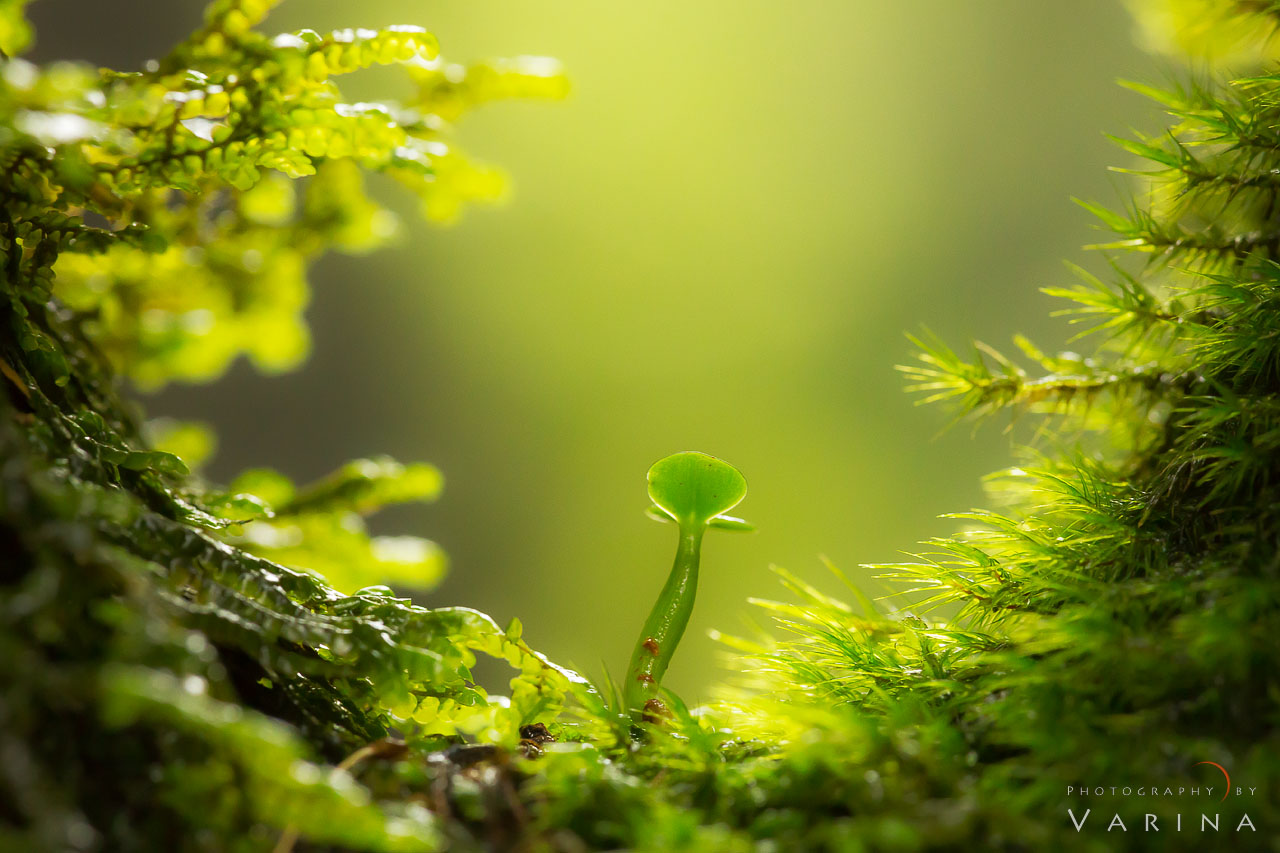
Backlit seedling with a clean backdrop makes the macro subject stand out.
I took this shot in the Mombacho Cloud Forest near Granada in Nicaragua. I used a macro lens to get in close to this beautiful little landscape – getting as close as I could to fill the frame with the rich greens and golden light. My subject – the tiny plant nestled in the cradle of a mossy branch – said more to me about the reality of this rich forest than any wide angle scene I captured that day. Every surface is covered with growing things. It is a cool respite from the heat of the city below the mountain… and the light – filtering through the canopy – is like something out of a fairy tale.
#7: Think about focus and depth of field
The closer you get to your subject, the narrower your depth of field will be. So, it can be really difficult to get your entire subject in sharp focus… even if it’s really tiny. In fact, the smaller your subject, the closer you’ll want to get to it – and the closer you get, the narrower your aperture will have to be to get everything in focus with a single shot. My 180mm macro lens lets my open my aperture to f2.8… which I love… but the reality is, when I get in really close, I often shoot at f16 (I took this shot at f10). I often find myself really pushing the focusing limits of my lens… wanting to get in closer and closer to my subject – until my lens is no longer capable of focusing at all. I back off until my lens will work for me – and no more. 😉 The key to getting the shot just right is in choosing your point of focus. In this shot, the eyes of the gecko are the most important elements in the frame, so they should be the sharpest part of the photo. My focus must be spot on, or the shot just doesn’t work.

Look for clean and simple negative space that offers a sense of place for your macro subject
For this shot, I adjusted my tripod and camera so that the edges of the leaves and the head of the gecko were within my plane of focus. The focus falls off behind the gecko, softening the background and the body of the gecko – and simplifying the scene. This composition works because the gecko’s head rests just at the edge of a leaf – within the plane of focus – and the repeating leaf patterns provide interesting background.
I often use a combination of techniques to get the effect I want in a finished image. My goal is always to call attention to my subject – so I work to build negative space that compliments and leads the eye. And what you leave out of an image is just as important and what you put in it – I am always looking for ways to eliminate distracting elements and dead space so my subject gets the attention it deserves.
Now remember – as always – these tips aren’t meant to be hard and fast rules… they are merely suggestions. You are the artist – so you make the rules.
What other tricks do you use to capture stunning macro photos? Feel free to share your ideas in the comments below.
About Author Varina Patel

There is nothing more remarkable to me than the power of nature. It is both cataclysmic and subtle. Slow and continuous erosion by water and wind can create landscapes every bit as astonishing as those shaped by catastrophic events – and minuscule details can be as breathtaking as grand vistas that stretch from one horizon to the other. Nature is incredibly diverse. Burning desert sands and mossy riverbanks… Brilliant sunbeams and fading alpenglow… Silent snowfall and raging summer storms… Each offers a unique opportunity. I am irresistibly drawn to the challenge of finding my next photograph, and mastering the skills required to capture it effectively.
Visual Wilderness https://ift.tt/3duICxc
Sourced by Time Trap Photography sharing the best photography tips, news and tricks throughout the industry. Time Trap Photography is dedicated to freezing those special moments in life that can be revisited and admired for generations to come. - Shannon Bourque
Please visit our main site for booking availability and rates.

Receive valuable industry knowledge delivered free to your email each day.



No comments:
Post a Comment
Thank you so much for your comment. A moderator will review and approve all relevant posts. We appreciate your support and encourage you to stay with us by subscribing to our email updates. Where you can easily pick and choose what photography subjects interests you. Subscription link: http://bit.ly/photo-sub